How Smart Investors Avoid Taxes (the B.B.D. hack)
Apr 11, 2026Read time - 4 minutes / Disclosure
Legally avoiding taxes can:
- Save you money.
- Make you money.
- Help you build generational wealth.
Unfortunately, taxes are a confusing thing.
The Costs
According to an article in Yahoo Finance.
The average American pays over $500,000 in taxes during their lifetime.
That's over 34% of the money an average person makes.
Yet most people aren't taught anything about taxes:
- In high school.
- While in college.
- While working a 9-5 job.
Taxes are a huge part of life.
And knowing how to avoid them (legally), means more money in your pocket.
"Death, taxes and childbirth. There's never a convenient time for any of them."
— Margaret Mitchell
In 2017, I remember peering out my tiny window watching a customer park his older Lexus SUV.
It had a few dents and some obvious scratches.
As he walked into the bank.
He looked to be in his early 50s.
A normal guy with a few questions about his accounts I figured.
At that point I'd been working in banking for 7 years.
But I'll never forget this guy.
He walked up to my desk and said he wanted to get a new loan on his house.
Let's call him Mike.
After chatting with Mike a few minutes.
I learned he had a loan on his house currently.
But wanted to get a new loan to replace the loan he already had.
And he wanted the new loan to be a bigger loan.
(this is called a "cash out refinance")
He wanted to take the cash he got from the new, bigger loan and buy another property.
The $50 Million
I also discovered Mike had $50 million dollars.
He was a retired CEO.
And that large sum of money was invested in the stock market.
Mike said he didn't want to touch the $50M.
That he wanted to get a bigger loan on his home instead.
And would use the money he got from the bigger loan to buy the new property.
While working in banking.
I came across many people like Mike.
(most of them didn't have $50M)
People that had the money to do the thing they wanted to do.
Or had assets they could sell to get the money to do the thing they wanted to do.
But instead they chose to get a loan.
It confused the hell out of me at first when I started working in banking.
Why they heck wouldn't they just use the money they already had?
Or sell something they owned to get the money they needed?
But I eventually learned Mike and other people like him thought differently.
They were playing a different game.
A game anyone can play.
"Utilizing the tax code to save as much money in taxes as possible is one of the most patriotic things you can do."
— Tom Wheelwright (author of Tax-Free Wealth)
The B.B.D Hack
Mike and other people I came across with his same mindset were using the B.B.D. hack to avoid paying taxes.
B.B.D. stands for Buy, Borrow, and Die.
A bit morbid.
But it's a way people legally avoid paying taxes in just 3 steps.
Let's dive in.
Step 1: Buy
Using income to buy assets is step 1 of the B.B.D strategy.
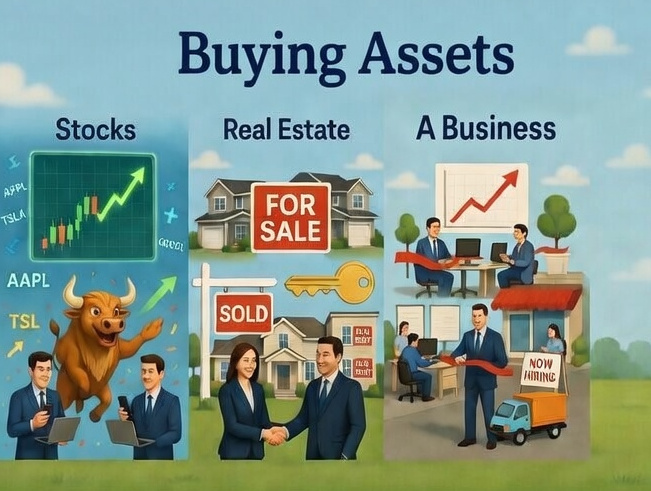
Ways people do this may include:
- Investing in the stock market using a general investing account (usually called a brokerage account).
- Investing in real estate by getting a loan to buy property.
- Starting and growing a small business.
Some people do one or two of these things.
And some people try to do all of them.
Owning assets that go up in value over time is the first step of the B.B.D. strategy.
Step 2: Borrow
Using loans to borrow against assets that go up in value over time is step 2 of the B.B.D strategy.
The stock market has been doubling in value every 7 to 8 years over the past 30 years.
So a small investment account over a long period of time may become a large investment account.
And the price of a home has been doubling in value every 14 to 15 years over the past 30 years.
So a home or a rental property bought using a home loan may be worth double or triple the original price paid over a long period of time.
The same thing can happen with a business.
Starting a small business and growing it over 5 or 10 years can become a large business worth a lot of money.
Instead of selling the stocks, selling the real estate, or selling the business.
To get access to the money.
(and possibly owe lots of taxes)
People using the B.B.D. strategy get loans against their assets to get access to their money.
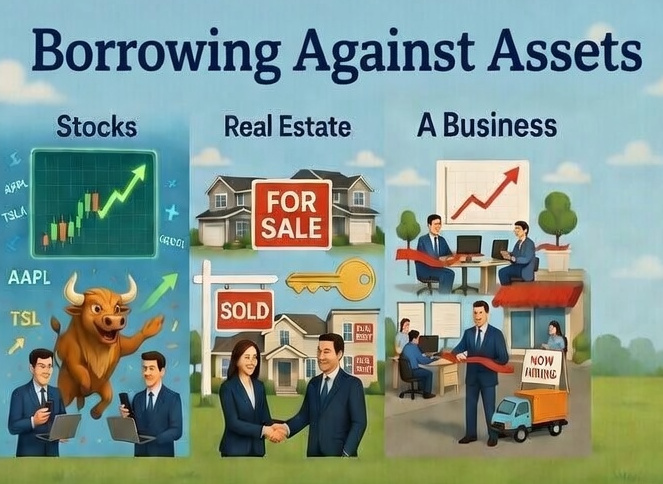
Ways people do this may include:
- Getting a loan against a general investing account.
- Getting a bigger loan against real estate they already own (like Mike did).
- Getting a loan against a business they own that's growing larger and larger.
Loans also mean having a monthly payment.
Which is also an important thing to consider.
Taking out loans against assets that go up in value over time to access money instead of selling assets and possibly owing a lot of money in taxes is the second step of the B.B.D. strategy.
Step 3: Die
Using death to transfer assets to family tax free is step 3 of the B.B.D strategy.
The IRS has a rule called "The Step Up Basis".
Here's how it works:
Let's say Susan over many years invests $30,000 in a general investing account.
And when she passes away.
The $30,000 she invested over many years grows to $150,000.
The IRS Step Up Basis Rule says:
If Susan passed away and her family inherited her $130,000 investment account.
And they sold the investments soon after.
They wouldn't be required to pay taxes on the $130,000.
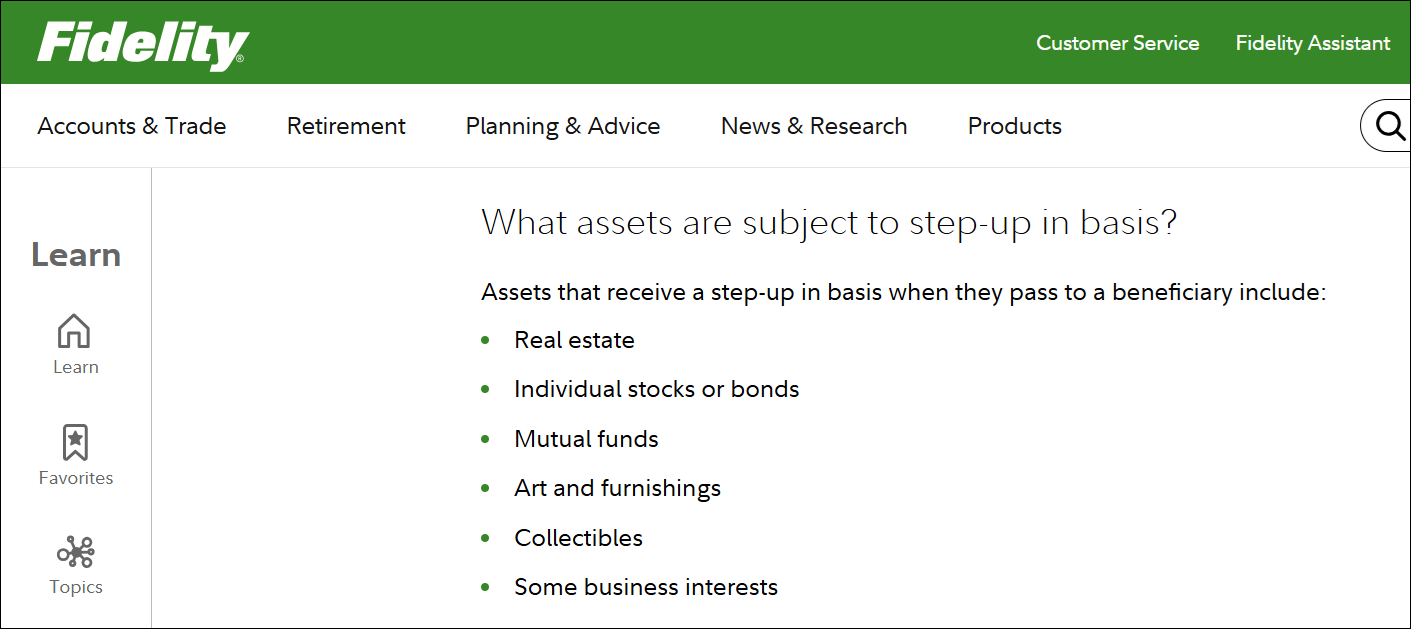
This rule applies to many different things like: stocks, real estate, or even a business.
Another example:
Let's say Susan got a loan and bought a home worth $400,000 a long time ago.
And when she passed away the home was worth $800,000.
And her family inherited her home.
And they sold it soon after.
According to the IRS Step Up Basis Rule:
Her family wouldn't be required to pay taxes on the $800,000 either.
You can read more about the tax benefits of inheriting investments here Fidelity: The Step-up in Basis.
Holding on to assets until death and allowing family to inherit those assets tax free is the third step of the B.B.D. strategy.
NOTE: With taxes it's important to talk with a professional about your individual situation.
The bottom line
Before working in banking I'd never heard of the B.B.D. strategy.
Especially as a younger guy that was raised in a lower income area.
It seemed like a strange concept at first.
But after working in finance.
And spending a lot of time with people that wanted to pay $0 taxes (like Mike).
I started thinking more about how I could use the B.B.D. strategy in my own life.
- To always compare the option of getting a loan instead of selling an asset.
- To always try and pay the least amount of money possible to the IRS.
- To leave as many assets behind as possible for family tax free.
I helped Mike 2 more times get real estate loans before leaving my banking job.
He's still proudly driving around that old Lexus SUV with the dents and scratches.
That's all for today.
See you next Saturday.