How to Start Investing (the 4 simple steps)
Nov 07, 2026Read time - 4 minutes / Disclosure
Today, let's review how to start investing.
Knowing how to invest can:
- Grow your savings.
- Boost your net worth.
- Make 9-5 life optional sooner.
Unfortunately, investing can be a confusing thing.
The Options
There's an endless amount of investment options like:
- Stocks.
- Commodities.
- Mutual Funds.
- Cryptocurrency.
- Exchange Traded Funds.
It can feel overwhelming.
Especially to a new investor.
And feeling overwhelmed often leads many people to do just one thing.
Nothing.
"Rule #1: Don't lose money."
"Rule #2: Don't forget rule #1."
— Warren Buffett
Like most people, I too feared losing money as a new investor.
So I did nothing.
But as the years passed, I knew I had to do something if I didn't want to work 9-5 my entire life.
So I started investing $100 per paycheck.
Each time I was paid, my employer deducted $100 and put it inside my retirement account at work.
And that money was invested in the stock market.
The Investing Problem
Most people who start investing:
- Do the minimum.
- Hope for the best.
- Don't understand their investments.
Things I also did and experienced.
Things I eventually realized wouldn't get me to my goal of leaving 9-5 life a few decades early to do my own thing.
But after I started working in banking.
It became obvious I needed to change my investing strategy.
The First 4 Steps of Investing
Working in banking for 10 years forced me to get better with my money.
And taught me only having a retirement account at work makes leaving 9-5 life early more difficult.
Because retirement accounts have restrictions.
Like how much money I could invest each year and when I could take my money out without paying a penalty.
So, I opened more investing accounts alongside my retirement account at work which eventually helped me reach $1M of investments in my 30s.
Here's the 4-steps.
Let's dive in:
1. Pick Your Brokerage Company
Popular stock investing companies include:
- Charles Schwab.
- Vanguard.
- Fidelity.
Picking a reputable brokerage company is the first step.
2. Choose an Account Type
Brokerage companies offer many account types (just like banks do).
And you don't have to pick just one account.
2 popular investment accounts for retirement include:
1. The Roth IRA (which stands for Individual Retirement Account).
2. The Traditional IRA.
And a popular non-retirement investment account includes:
- The General Investing Account (sometimes called a taxable brokerage account).
I like to think of a general investing account as "before retirement age" money.
Which means money that's available to spend in the 20s, 30s, 40s, and 50s.
And I like to think of retirement accounts as "retirement age" money.
Which means money meant to be spent in the 60s, 70s+.
Opening an account takes 5-10 minutes online.
Having multiple accounts gives you more ways to build wealth (and more ways to access your money).
3. Select Investments
Have an investment strategy.
A popular quote by a billionaire investor reads:
"The goal of non-professionals shouldn't be to pick winners, rather to own businesses bound to do well, a low-cost S&P 500 ETF will achieve this goal."
— Warren Buffett
Instead of picking individual stocks.
Buffett's opinion is that everyday investors should simply invest in an S&P500 ETF.
Which includes 500 of the largest companies in America like:
- Apple.
- NVDA.
- Google.
- Amazon.
- Microsoft.
And over the last 40 years, if someone saved $5 a day and invested $150 a month into the S&P500.
Here's how it worked out:
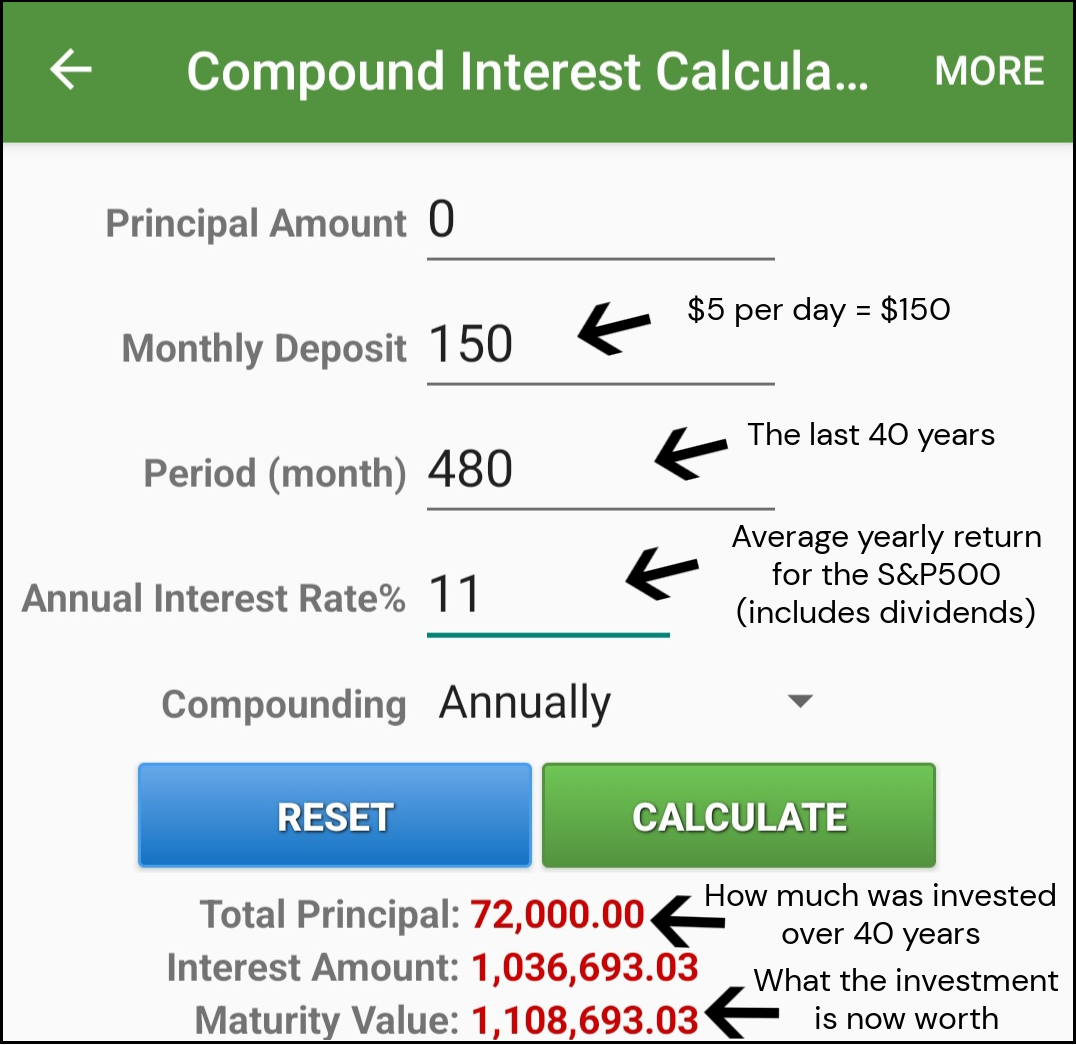
(although there's no guarantees the next 40 years will look exactly the same)
One of the largest S&P500 ETFs currently is:
- The Vanguard S&P500 (VOO)
Vanguard also has a helpful guide explaining ETFs:
ETFs help you invest without having to become an expert at picking stocks.
4. Build Your Wealth on Autopilot
Automate your investments so you don't have to lift a finger.
For example:
On payday, having money automatically transfer to:
- Your retirement accounts.
- Your general investing account.
- And automatically buying your investments.
Automating your investments each month helps move you closer to your investing goals (and makes it easy).
The bottom line
Investing can be confusing.
Especially in the beginning.
One of my biggest investing mistakes was not getting started sooner.
Thinking I needed to be really smart to make money as an investor.
Thinking I needed to read finance articles everyday.
Thinking I needed to know a lot about the stock market.
But the interesting thing.
When my investments crossed $1M before leaving my 9-5.
They only included 2 types of investments:
1. An S&P500 ETF (like Warren Buffett suggestions).
2. Real Estate: Using loans to buy and own a few rental properties.
My easiest investment by far has been an S&P500 ETF.
(although I'll always be a big fan of real estate too)
I'm not sure where you're at on your investing journey.
Maybe you're just getting started.
Or maybe you've already hit your first $10k, or your first $100k.
But I hope sharing my journey and what I've learned along the way is useful, and appreciate you reading it.
That's all for today.
See you next Saturday.