The Simple Path to Investing (5 steps to build wealth)
May 09, 2026Read time - 4 minutes / Disclosure
Learning how to invest can:
- Lower your stress.
- Boost your savings.
- Offer you a freer life.
Unfortunately, investing can be a confusing thing.
The Math
Making sense of investing terms like:
- Stockholders equity.
- Compound interest.
- Rate of inflation.
...can scare the heck out of any new investor.
It did to me at first.
Which can also lead to not investing.
But that means missing out on stock market growth:
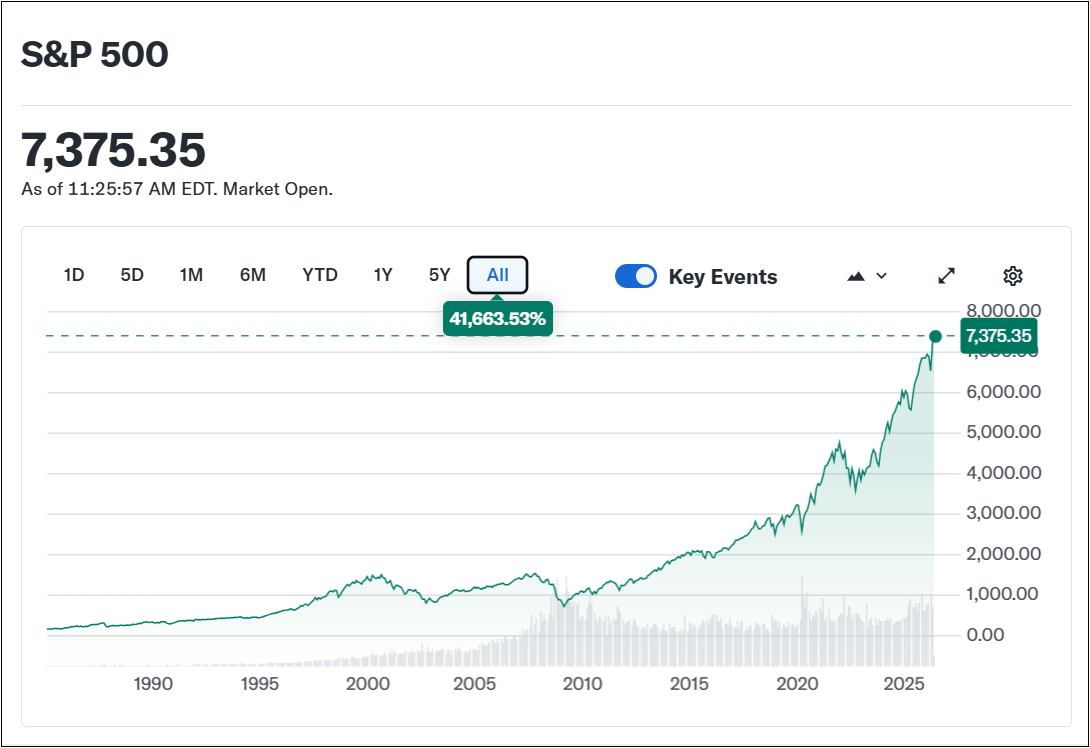
40 years of the stock market
Like it was last month, I remember starting my first investment account.
I didn't know much.
And didn't have much money to invest.
But after learning the stock market has been going up 11% per year on average the past 40 years...
I didn't want to miss out.
So to figure out how much I wanted to start investing..
I imagined I was starting from scratch 40 years ago to see how much money I'd have today if I'd invested in the S&P500 (which is the 500 largest companies in America).
Running a few experiments on an investing calculator.
Excited the heck out of me to get going.
Here's the 3 experiments:
1. The $5 Experiment
Saving $5 per day meant:
- $150 invested per month.
- Into the S&P500.
- The last 40yrs.
And it looked like this:
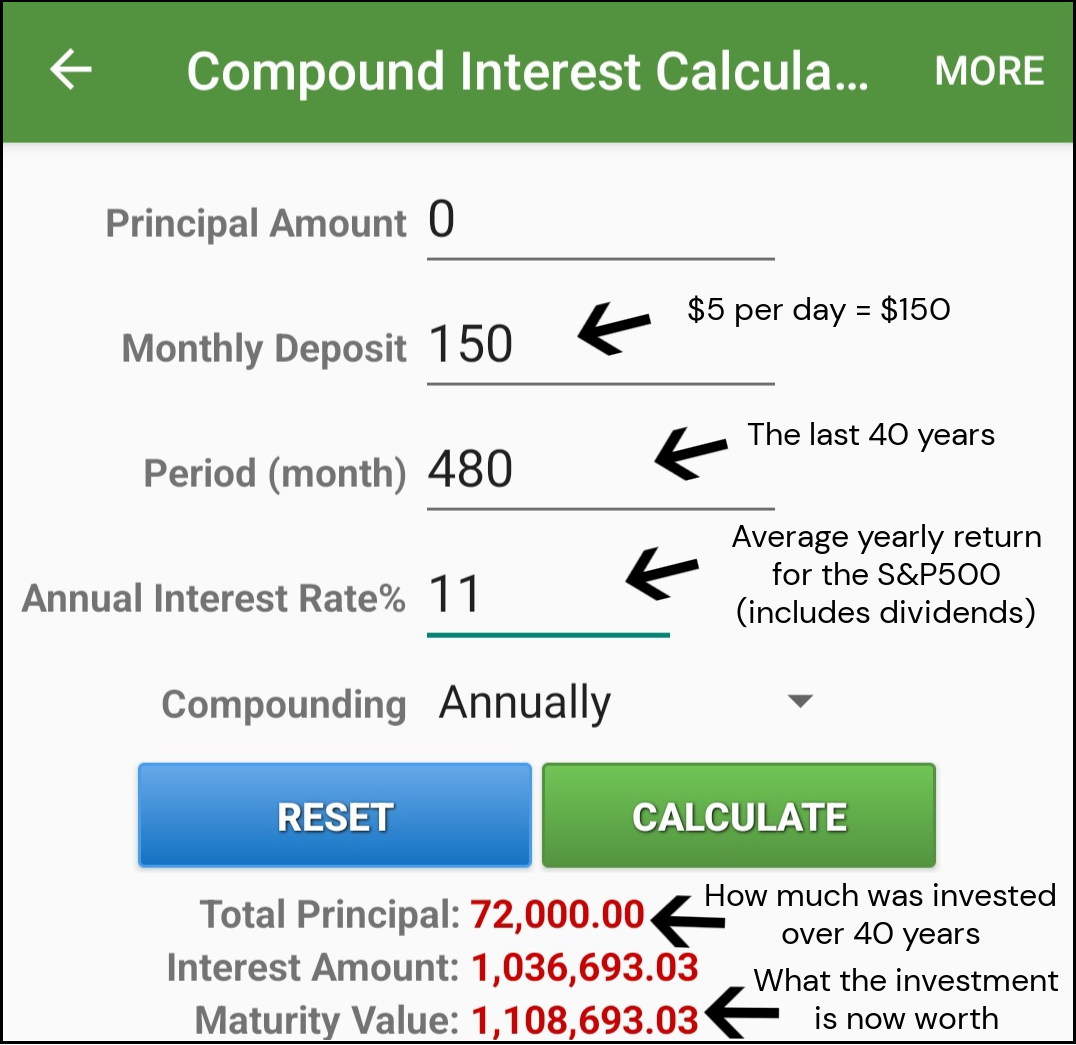
Investing $150 per month ($5 per day) into the S&P500 the last 40 years = $1,108,693
2. The $10 Experiment
Saving $10 per day meant:
- $300 invested per month.
- Into the S&P500.
- The last 40yrs.
And it looked like this:
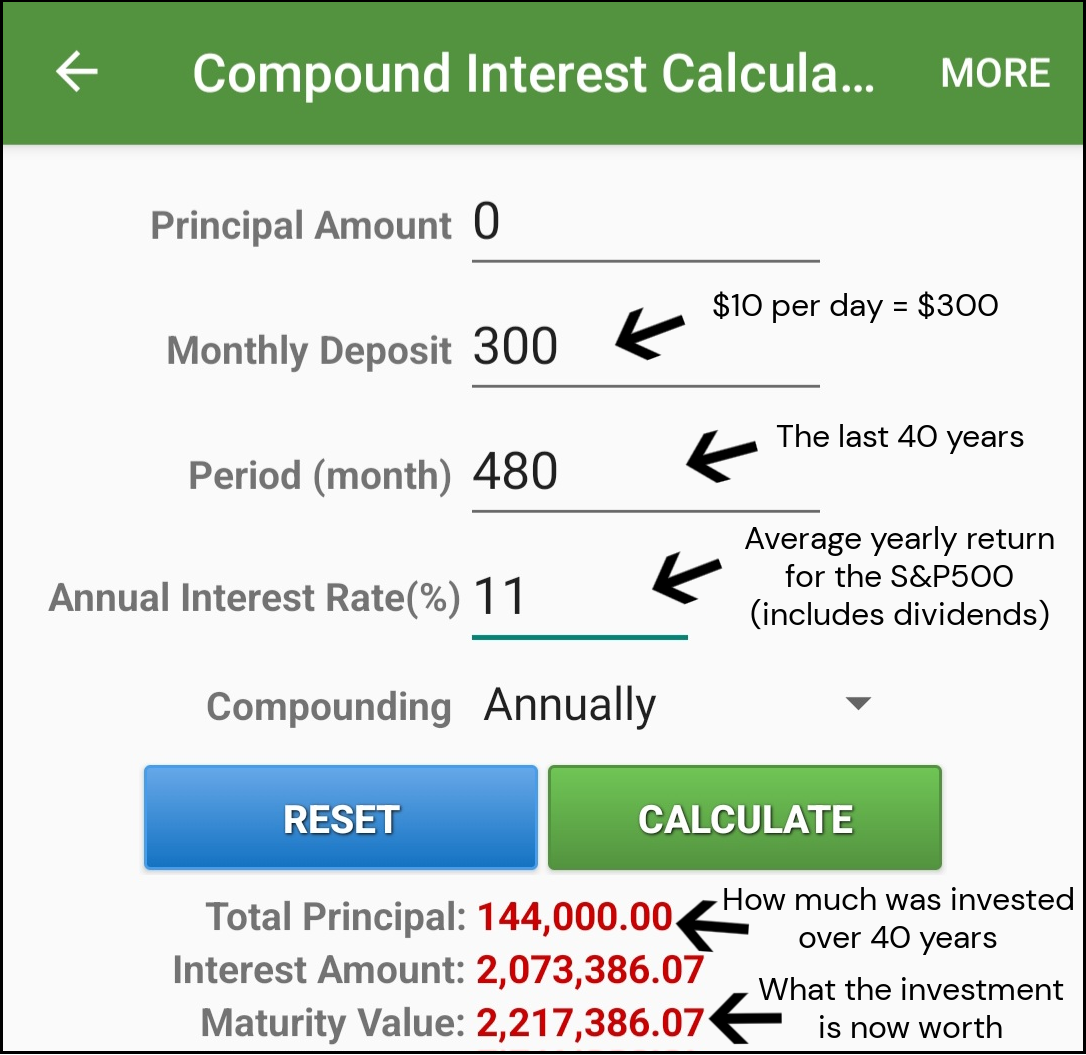
Investing $300 per month ($10 per day) into the S&P500 the last 40 years = $2,217,386
3. The $20 Experiment
Saving $20 per day meant:
- $600 invested per month.
- Into the S&P500.
- The last 40yrs.
And it looked like this:
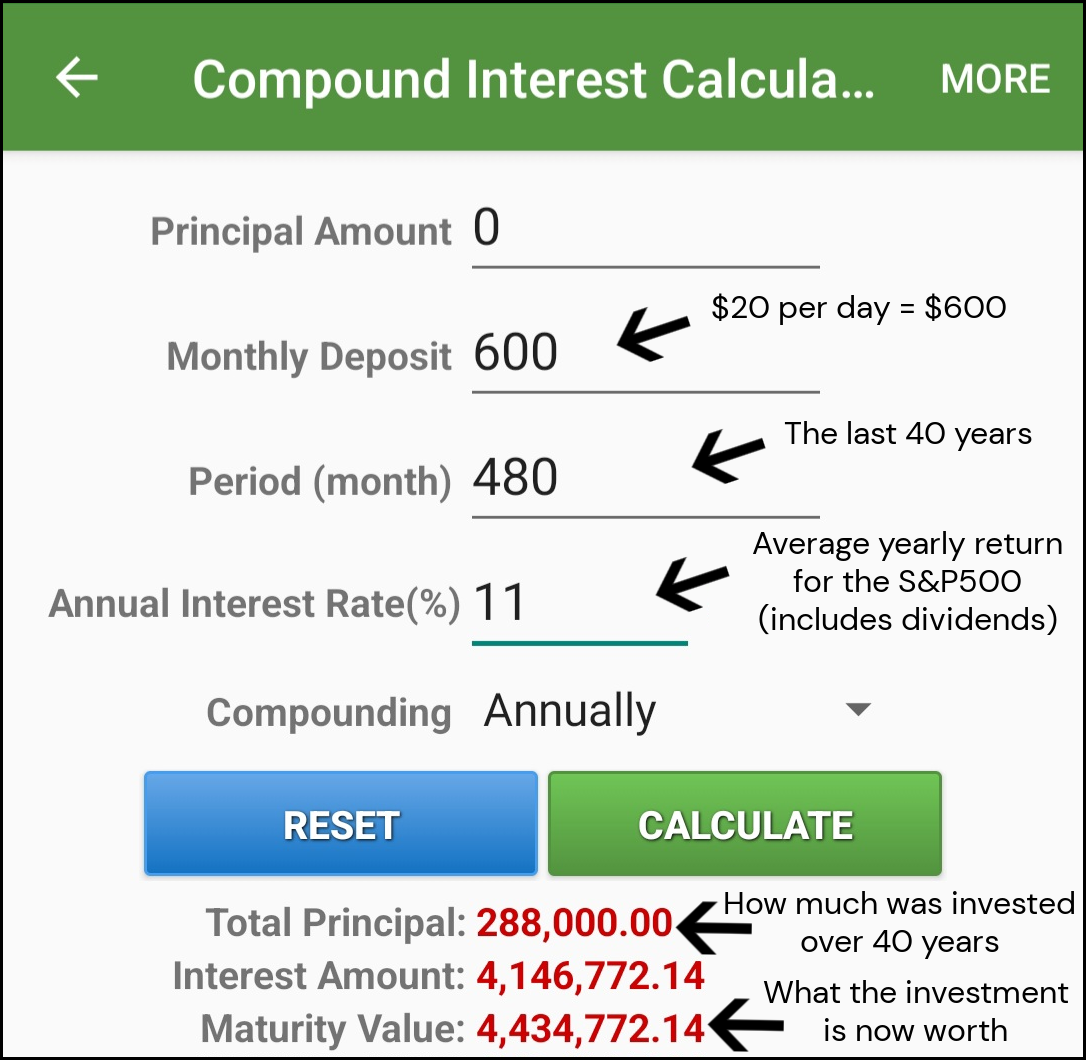
Investing $600 per month ($20 per day) into the S&P500 the last 40 years = $4,434,772
"All the benefits in life come from compound interest (money, learning, relationships)."
— Naval Ravikant
The 5 Steps To Investing
It's easy to complicate investing.
Here's 5 simple steps to start building wealth on autopilot.
Let's dive in.
1. The Brokerage
Choose a stock brokerage company.
Popular choices include:
- Charles Schwab.
- Vanguard.
- Fidelity.
Fidelity is one of my oldest investing accounts.
Pick a reputable stock brokerage company to start investing.
2. The Account Type
Open an investing account with your new stock broker.
Popular Retirement Accounts include:
- The Traditional IRA.
- The Roth IRA.
And a popular non-retirement account includes:
- The General Investing Account (sometimes called a taxable brokerage account).
I like to think of a general investing account as "before retirement age" money.
Which means money that's available to spend in the 20s, 30s, 40s, and 50s.
And I like to think of retirement accounts as "retirement age" money.
Which means money meant to be spent in the 60s, 70s, 80s+.
Each account takes 5-10 minutes to open online.
Having retirement accounts plus a general investing account can help you build wealth faster.
3. The Investing Order
Contribute your money in order.
My favorite step-by-step playbook to follow:
1. Contribute to the retirement account at work up to the company match (if offered).
2. Contribute to the Roth/Traditional IRA (up to $7,500 which is the max in 2026).
3. Contribute more to the retirement account at work (maxing it out if possible).
4. Contribute to the general investing account (aka: early retirement money).
Using different accounts gives you more flexibility in retirement (and the possibility of leaving 9-5 life early).
4. The Simple Strategy
Have an easy investing strategy.
Picking 1, 2, or 3 low cost stock ETF's makes investing easy.
Just 1 stock ETF can include hundreds of individual stocks.
(I prefer an S&P500 ETF like VOO which includes 500 of the largest companies in America)
Vanguard has a helpful guide explaining ETFs:
After picking your ETFs.
Automate everything.
For example:
On payday, have money automatically go into:
- Your Retirement Accounts.
- Your General Investing Account.
Using Stock ETF's and automatic investing helps you stay on track every month without having to lift a finger.
5. The Compounding Machine
Patience pays in the long run.
The math of investing just 5%
— JOHN HENRY (@thejohnhenry) October 20, 2025
of a $75,000 salary:
If a job matches the 5%—
Here’s how it's looked the last
30 years in stocks (S&P500):
- $371k in 15 years
- $491k in 20 years
- $1.4M in 30 years
Wild.
"Compound interest is the 8th wonder of the world." — Albert Einstein
The bottom line
Investing can be dang confusing.
There's so many options.
Fear of doing the wrong thing, can lead to doing nothing at all.
But doing nothing at all, can lead to working an entire lifetime.
Always having a boss.
Always having short vacations.
Always having to live the 9-5 life.
When I first started investing, I only had $100 to spare each paycheck.
It didn't feel worth it.
And I struggled to pay off $80k in debt near the beginning of my journey.
But staying consistent paid off.
And I was able to invest more over time.
Which eventually turned into $1M of investments at age 36.
If you're near the beginning of your investing journey.
Or maybe you've hit your first $10,000.
Or maybe you've hit your first $100,000.
I'm rooting for you.
That's all for today.
See you next Saturday.