The Tax-Free Investing Option (5 things to know)
Aug 29, 2026Read time - 4 minutes / Disclosure
Legally avoiding taxes can:
- Save you money.
- Make you money.
- Help you leave 9-5 life sooner.
Unfortunately, taxes are a big part of life.
The Lifetime Tax
According to a recent article by Yahoo Finance.
The average person pays over $700,000 in taxes during their lifetime which includes:
- Sales tax.
- Payroll tax.
- Income tax.
- Property tax.
- Plus many more.
It can be frustrating.
Especially if looking at a paycheck and seeing how much money was subtracted in total taxes.
But there's also ways to save on taxes.
Ways they don't teach in school.
Ways worth knowing.
This recent viral post got me thinking about one of those ways.
It still blows my mind that if you max out your Roth IRA at $7,500 a year starting at 25, you’ll have roughly $2.3 million by age 60, completely tax-free.
— Darrell Aden (@darrelltalksfi) August 24, 2026
Why aren’t more people doing this?
It got me thinking about the beginning of my investing journey.
And starting with a 401k retirement account offered by my employer.
Up until that point, none of my previous jobs offered a retirement account.
And I didn't have much money to invest.
But learning about my first retirement account while working at an AT&T cellphone cart in the mall near Los Angeles in my 20s changed everything.
The Millionaire Math
Building $1M of investments from scratch while working my 9-5 job felt impossible at first.
But learning if I put $100 into my retirement account automatically each time I was paid.
And my employer also put in $100.
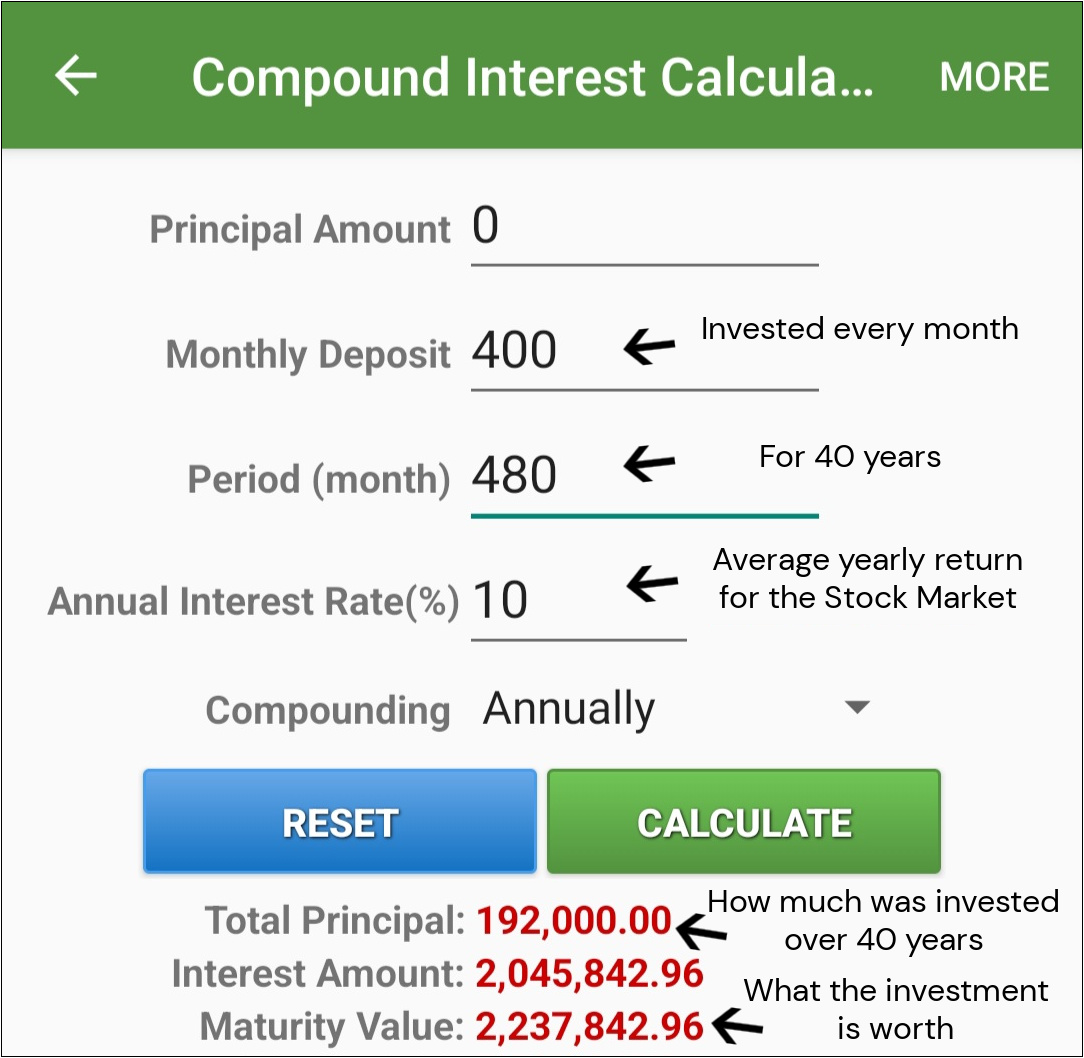
That meant I'd have $400 going towards retirement every month ($200 from me and $200 from my job).
While tinkering with the retirement account online.
I also learned the money would be invested in the stock market, which grows 10% bigger each year on average.
And the online investment calculator estimated I'd have this much money in the account in my 60s if I stuck with that plan:
It blew my mind.
And I had a hard time believing it at first.
How could investing $100 per paycheck.
Plus getting a $100 match from my employer each time I was paid turn into $2M?
After tinkering with the online calculator a bit more, I realized the math was right.
"Compound interest is the 8th wonder of the world."
— Albert Einstein
The thought of becoming a millionaire while selling cellphones in the mall for 40 years was amusing at the time.
But learning these things about investing motivated me to get started.
Eventually, I no longer sold cellphones in the mall.
And spent 10 years working as a banker at a local Chase Bank.
Which helped me learn how to get rid of my $80,000 of debt and build $1M of investments in my 30s.
It was a wild ride.
And I also made some painful mistakes along the way.
But it's also where I learned about investing tax-free.
The Powerful Roth IRA
Here's 5 things to know about tax-free investing using a Roth IRA (things I wish I knew sooner).
Hope it's helpful.
Let's dive in.
1. What Is A Roth IRA?
A Roth IRA grows your retirement savings tax-free.
Investment growth inside a Roth is tax-free.
And money taken out of a Roth in retirement is tax-free.
Opening a Roth IRA is a great way to invest while legally avoiding taxes.
2. How Does It Work?
The Roth IRA has annual contribution limits based on your age.
Which means your age determines how much you can invest inside a Roth IRA.
The current limits:
If you're under 50 and want to contribute the maximum each year to a Roth IRA, you'd need to save around $20 per day (less works too).
3. Who Can Use It?
To be eligible to use a Roth IRA, you must make less than the IRS income limit.
If you're single:
You must make less than $168,000 per year.
If you're married:
You much make less than $252,000 per year.
But one important thing to know...
Many employers who offer a retirement account, also offer the Roth 401k option.
And with the Roth 401k:
- Anyone can contribute.
- The annual contribution limit is higher.
Using a Roth IRA means opening your own account if you're under the annual income limit, or using a Roth 401k at work if your employer offers it, or using both (if you want).
4. What Else Is There To Know?
Here's a few more things worth knowing:
- If you take money you earned from investments out of a Roth IRA before age 59 1/2 you'll pay a 10% penalty, but special exceptions are allowed like buying a home.
- But if you take money you deposited into an Roth IRA out there's no penalties, you can withdraw money you deposited anytime, for any reason.
- After opening a Roth IRA, don't forget to pick your investments. My favorite retirement account investment is an S&P500 fund.
- You can start investing using a Roth IRA with as little is $1.
A Roth IRA is one of the most flexible retirement accounts and can grow your retirement savings tax-free.
5. Where Can I Open One?
There's thousands of online investment companies that offer the Roth IRA.
Here's 3 of the largest ones:
- Vanguard.
- Fidelity.
- Schwab.
You can open a Roth IRA online in just 10 minutes.
The bottom line
Learning about investing accounts can feel overwhelming at first.
It did to me.
But like learning anything new, it gets easier with time.
One investing hack I wish I learned sooner was to think in days instead of months.
For example:
The thought of investing $300 a month near the beginning of my investing journey felt impossible.
But after realizing $300 per month works out to saving $10 per day to invest.
It felt doable.
After setting up my investments to come out of my paychecks automatically.
And watching those investments grow.
From $100 to $1,000.
From $1,000 to $10,000.
From $10,000 to $100,000+
It was exciting.
Month after month.
Year after year.
Making money with your money to build a freer life and watching it grow is a beautiful thing.
That's all for today.
See you next Saturday.